These frameworks help you consider where and how to intervene in a complex system and what influence you might expect to have on it.
Donella Meadows (1941–2001) originally described “leverage points” for intervening in complex systems this way: “These are places within a complex system (a corporation, an economy, a living body, a city, an ecosystem) where a small shift in one thing can produce big changes in everything.”
The frameworks here all build upon or respond to Donella Meadows’ original work (Places to Intervene). The Intervention Level Framework makes Meadows’ framework easier to use for research and classification. The Action Scales Model is a mashup of Meadows’ framework, the Intervention Level Framework, and the Iceberg Model. The Systems Change Tree is an adaptation of the Iceberg Model that features the interdependence of system levels.
These frameworks recognize the primacy of values, beliefs, and mental models as key drivers that shape behaviour and outcomes. Beliefs and mental models are framed as the invisible tip of the iceberg (Iceberg Model, Six Conditions for Systems Change), the heaviest weight on the scales (Action Scales Model), and the deep roots of a tree (Systems Change Tree). The Four Shades of Change and Innovation label this part of the system, “narratives,” and the Intervention Level Framework suggests that this level is the hardest to influence but can have the most impact.
Another core theme is that visible symptoms, features, and characteristics are only surface manifestations of deeper, less visible underlying factors. Most of what strongly influences a system’s behavior is at least partially hidden, residing beneath the surface and involving elements that are not immediately (or possibly ever) apparent.
Frameworks in this collection
-
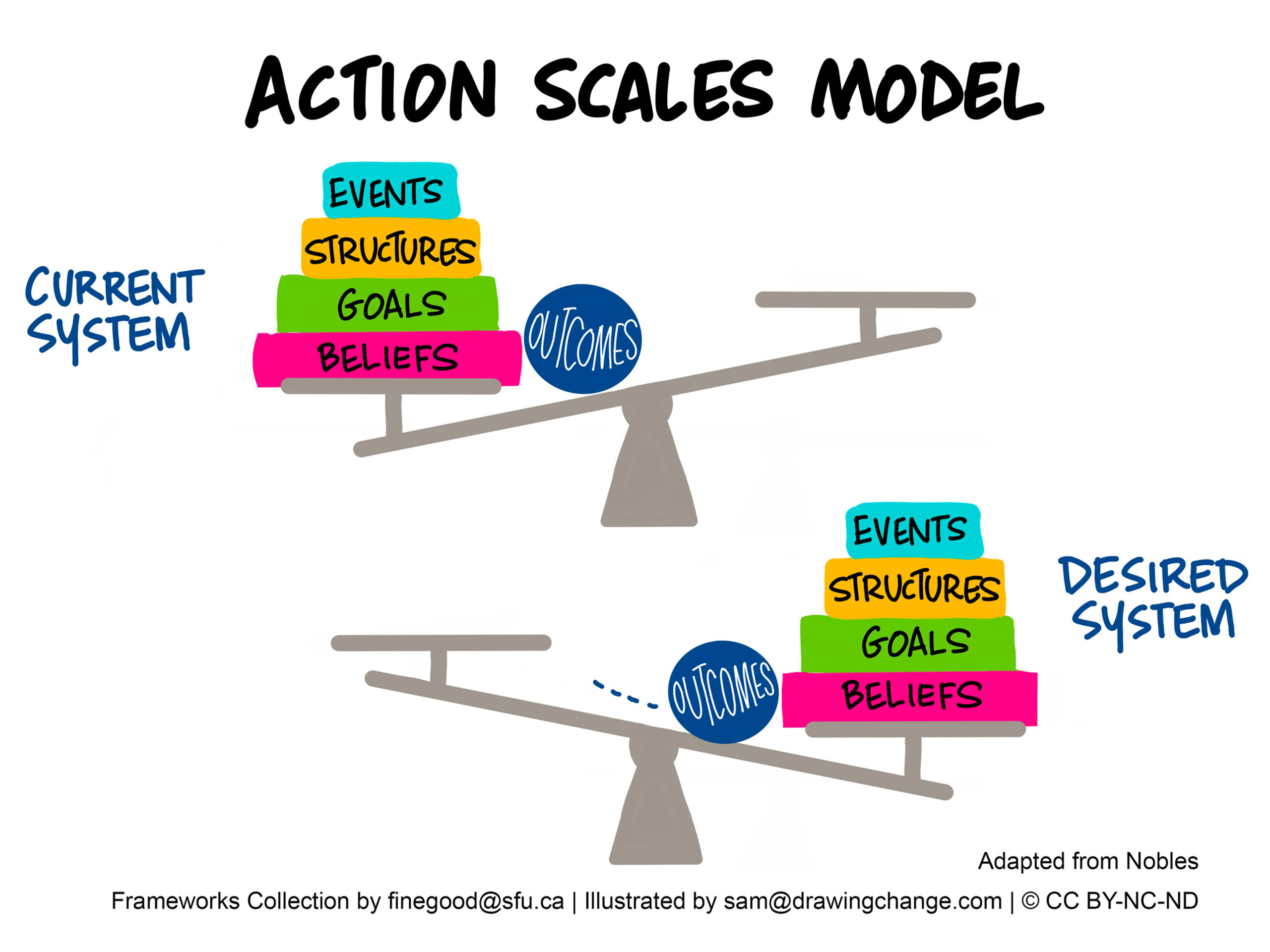
Action Scales Model
The Action Scales Model (ASM) is a framework intended for policymakers, practitioners, and evaluators to help identify and implement interventions… Read more
-

Four Shades of Change and Innovation
The Four Shades of Change and Innovation model was introduced by Avelino and colleagues in 2019. The four shades refer… Read more
-

Iceberg Model
The iceberg can be a helpful framework for unpacking a complex challenge at multiple levels. Edward T. Hall introduced the iceberg… Read more
-

Intervention Level Framework
In 2014, my research group adapted Donella Meadows’ seminal work on systems change by organizing her original twelve “places to… Read more
-

Places to Intervene
The idea of “places to intervene in a system” comes from Donella Meadows’ influential work on systems thinking. She identified… Read more
-

Six Conditions for Systems Change
In a 2018 monograph on the “water” of system change, Kania, Kramer, and Senge describe “six interdependent conditions that typically play significant… Read more
-

Systems Change Tree
The Systems Change Tree was adapted from the Iceberg Model by Jill Andres, Carole Muriithi and Elder Robert Greene (with the original… Read more