The Action Scales Model (ASM) is a framework intended for policymakers, practitioners, and evaluators to help identify and implement interventions within complex adaptive systems.
The ASM builds on other frameworks, including Meadow’s Places to Intervene, the Iceberg Model, and the Intervention Level Framework. Like these models, ASM highlights the interconnectedness of systemic elements and the power of intervening at different levels or places in the system. ASM prioritizes simplicity and real-world usability to make it accessible for practitioners with limited systems science expertise.
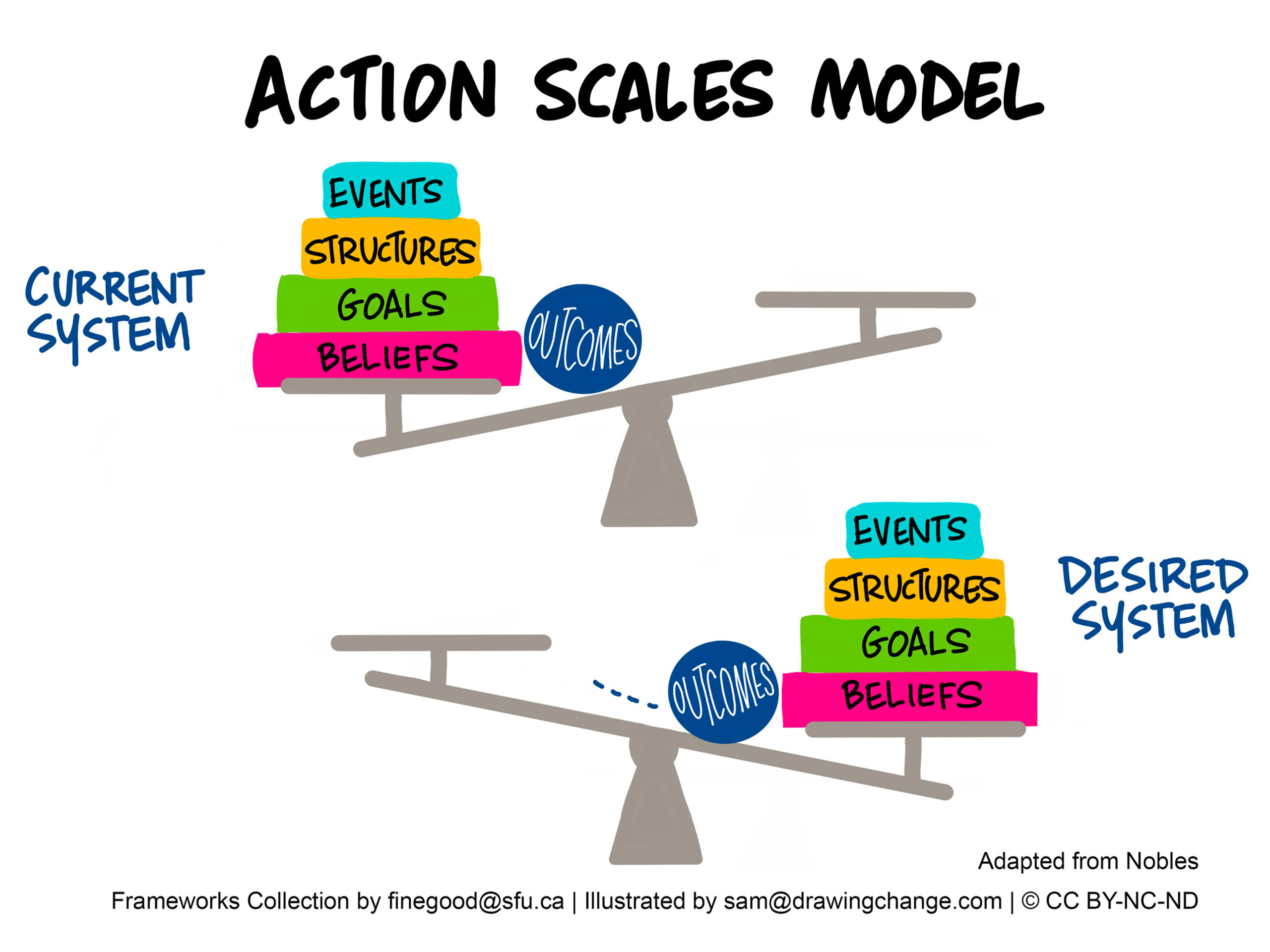
The ASM visualizes a system as a scale that is balanced by the current system on one side and by the desired system on the other. Each system is represented by four interconnected levels:
- Events: The observable outcomes or behaviors (surface-level action).
- Structures: The underlying physical, relational, or informational systems that produce events (processes and rules).
- Goals: The explicit or implicit target that drive system behaviors (its underlying objectives).
- Beliefs: The foundational norms, attitudes, and values shaping the system’s goals and structures (its deep values and assumptions).
Outcomes “roll” towards the heavier side (current or desired). While many interventions focus on event-level actions, the ASM suggests that deeper, more transformative changes occur at the levels of beliefs and goals. Because beliefs and goals carry more “weight,” targeting them for intervention has a higher chance to create lasting shifts in outcomes. But the heavier weight also means these levels are harder to change.
Consider the challenge of childhood obesity. Most programs act at the event level—like holding a Healthy Lunch Day that encourages students to bring or try nutritious foods. ASM suggests that deeper change comes from shifting structures, like menu policies and agreements with local suppliers of fresh fruits and vegetables. Goals are what the school wants to achieve, such as a supportive environment and appropriately trained staff who promote positive food choices. Beliefs like, “Kids won’t eat vegetables anyway,” or “Healthy eating is a shared responsibility,” will help or hinder many parts of the overall system.
Deeper Dive
- Nobles JD, D Radley, OT Mytton. The Action Scales Model: A conceptual tool to identify key points for action within complex adaptive systems. Perspectives in Public Health. 142(6):328-337, 2022.
Related Frameworks
- Four Shades of Change: takes a transformative social innovation perspective
- Iceberg: illustrates that some levels are mostly invisible
- Intervention Level Framework: adaptation of Places to Intervene for research purposes
- Places to Intervene: includes twelve different levels
- Six Conditions for Systems Change: accessible to leaders and decision-makers
- Systems Change Tree: nature-based reflection on the connection between levels