-

Accountability to Learning
Making the paradigm shift from accountability to learning is helpful in the management of complex organizations and systems, especially when… Read more
-
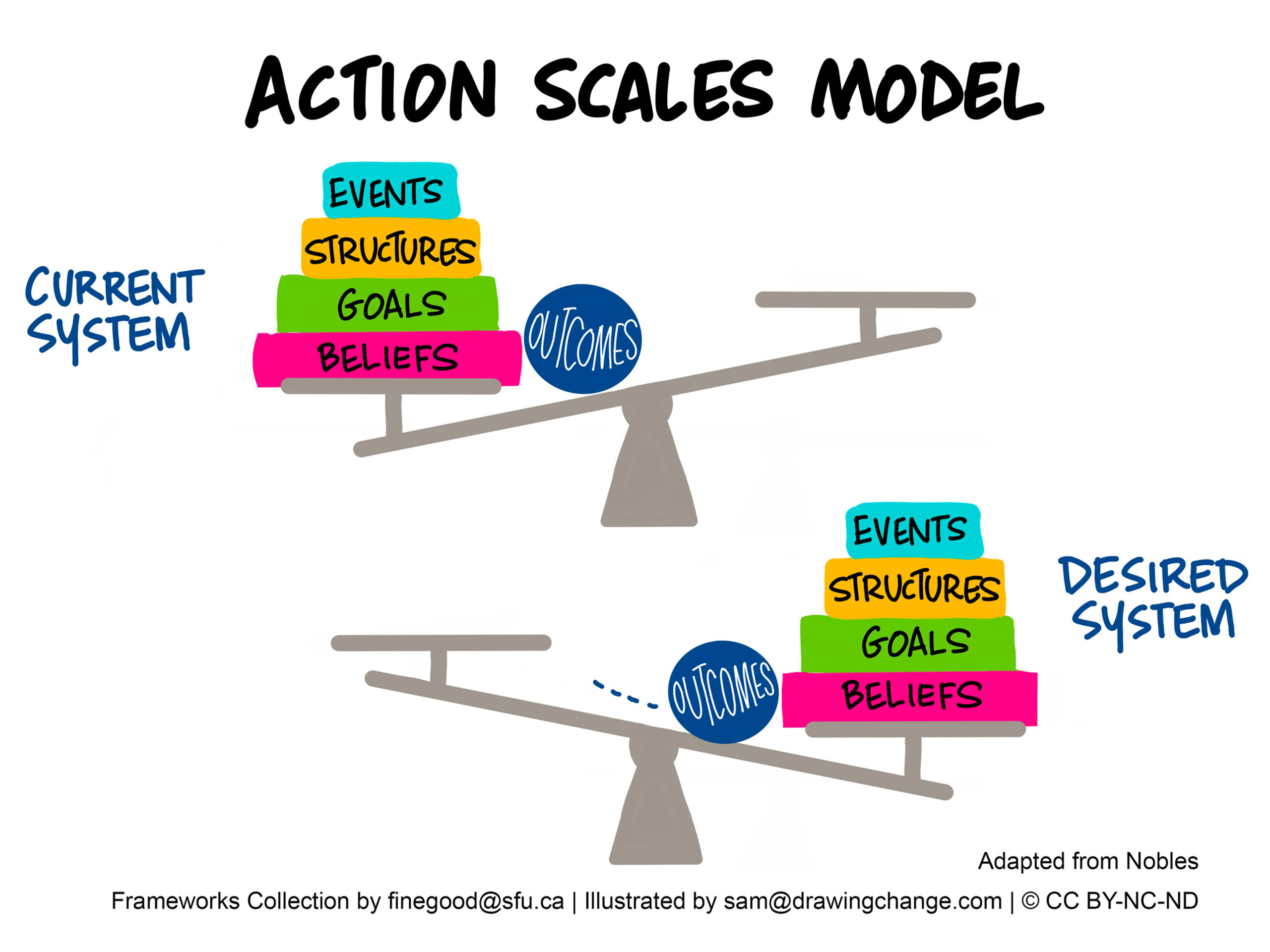
Action Scales Model
The Action Scales Model (ASM) is a framework intended for policymakers, practitioners, and evaluators to help identify and implement interventions… Read more
-

Adaptive Cycle
CS Holling first introduced the concept of the adaptive cycle in 1986 to describe cycles of change in ecosystems. The… Read more
-

Alignment to Coherence
This framework is a collection of metaphors for thinking about systems at micro and macro levels, or with a Zoom… Read more
-

Cake Rocket Child
The differences between simple, complicated, and complex were described by Glouberman and Zimmerman with the Cake Rocket Child analogy in… Read more
-

Collaboration Spectrum
A spectrum of collaboration from competition to integration was introduced by Liz Weaver and the Tamarack Institute in the early… Read more
-

Collective Impact
The concept of collective impact was first outlined in a 2011 Stanford Social Innovation Review article by Kania and Kramer. The article… Read more
-

Community of Practice
The term community of practice (CoP) is understood and used here to refer to a group of people who come… Read more
-

Competition and Collaboration
We often think of competition and collaboration as opposites or activities opposing each other. This is a notion reinforced by… Read more
-

Complex versus Complicated
Complex is not the same as complicated. Complicated systems have predictable outcomes. With enough information and understanding, you can forecast… Read more
-

Complexity Theory of Outcome Creation
The Complexity Theory of Outcome Creation (CTOC) was introduced by French and his colleagues in 2023 to explain how complex… Read more
-

Define Boundaries
When engaging with complex challenges, it’s important to define the boundaries of your system of interest—the specific challenge or phenomenon… Read more
-

Diagonal Model
The Diagonal Model was developed for addressing complex health system challenges. It helps reconcile and integrate previously perceived dichotomies between… Read more
-

Feedback Loops
Feedback loops are places where the output of a process is fed back into the system as input, influencing future action.… Read more
-

Four Shades of Change and Innovation
The Four Shades of Change and Innovation model was introduced by Avelino and colleagues in 2019. The four shades refer… Read more
-

Four Types of Human Complexity
The Complexity Theory of Outcome Creation from French and colleagues describes four types of human complexity which contribute to the emergence of… Read more
-

Fragile to Antifragile
Nassim Nicholas Taleb introduced the concept of antifragile as, “Things that gain from disorder,” in his 2012 book, Antifragile. In… Read more
-

Help It Happen
This framework is adapted from the work of Trish Greenhalgh on the diffusion of innovation. Her classic meta-narrative included the original figure from… Read more
-

Iceberg Model
The iceberg can be a helpful framework for unpacking a complex challenge at multiple levels. Edward T. Hall introduced the iceberg… Read more
-

Information and Agency
In systems designed for complicated problems, information and agency are often not well balanced. High-level decision-makers usually lack detailed frontline… Read more
-

Intervention Level Framework
In 2014, my research group adapted Donella Meadows’ seminal work on systems change by organizing her original twelve “places to… Read more
-

Knowledge Cycle
Humans have been thinking, talking, and writing about knowledge for thousands of years. The knowledge cycle can be traced back… Read more
-

Match Capacity and Complexity
The concept of matching capacity to complexity was described by Yaneer Bar-Yam, based on his study of living systems. He notes that… Read more
-

Motivational Engagement
The Motivational Engagement model, adapted from Palsola and colleagues (2023), is a framework designed to help individuals—especially in health, education,… Read more
-

Order to Chaos
In this framework, an ocean wave is the metaphor for how order, complexity, and chaos exist on a continuum with… Read more
-

Places to Intervene
The idea of “places to intervene in a system” comes from Donella Meadows’ influential work on systems thinking. She identified… Read more
-

Process of Building Trust
Trust is the invisible engine that powers effective collaboration, especially in complex systems like healthcare and community development. Adam and… Read more
-

Rules to Principles
Complicated systems lend themselves to rules. Rules describe actions that must be aligned in a single direction, and they assume a synchronization of time, effort, and/or… Read more
-

Six Conditions for Systems Change
In a 2018 monograph on the “water” of system change, Kania, Kramer, and Senge describe “six interdependent conditions that typically play significant… Read more
-

Stacey Matrix
The Stacey Matrix is a visual tool that helps leaders and teams decide how to act based on two factors:… Read more
-

Strength of Ties
Mark Granovetter’s influential 1973 theory, “The Strength of Weak Ties,” advanced how we understand social networks. Before Granovetter, sociologists believed… Read more
-

Systems Change Tree
The Systems Change Tree was adapted from the Iceberg Model by Jill Andres, Carole Muriithi and Elder Robert Greene (with the original… Read more
-

Three Horizons Model
The Three Horizons Model is a helpful framework for understanding and navigating dynamic complexity, especially in contexts where innovation, transformation,… Read more
-

Transactional to Relational
Transactional approaches are helpful in complicated systems where there are clear cause-and-effect relationships. Think about your experiences with vending machines.… Read more
-

Triple Loop Learning
The concept of triple loop learning does not have a single clear originator—it seems to have evolved from earlier ideas… Read more
-

Trust and Complexity
The image for this framework illustrates a central insight from Solomon and Flores’s, Building Trust: In Business, Politics, Relationships, and… Read more
-

Two Loop Model
The Berkana Two-Loop Model, as described by Margaret Wheatley and Deborah Frieze, is a map for creating change in living and social systems. It… Read more
-

Types of Trust
Solomon and Flores (2003) identify four distinct types of trust that shape how individuals and organizations relate to one another.… Read more
-

Zoom In, Zoom Out
This image captures an important component of defining boundaries: the value of consciously choosing our conceptual frames or paradigms when… Read more
